Showing posts with label Baseline Data and Progress Checks. Show all posts

Sunday, November 1, 2015

Product Feature: Wh Questions Progress Monitoring Tool

In May of this year, I realized that I needed to create a WH Questions Progress Monitoring Tool because so many children on my caseload were working on improving their language processing skills in this area. I provide therapy services for many children who have receptive/expressive language disorder with co-occurring autism, specific learning disability, and/or intellectual disability and struggle immensely with this skill. 

This tool has really enabled me to improve my ability to take data prior to beginning intervention with kids and after several speech-language therapy sessions.  

Last month, I expanded this tool from 6 progress monitoring forms with 75 question probes to 12 progress monitoring forms with 165 question probes to evaluate children's ability to answer who, what, where, when, and why questions about everyday events. This informal assessment is ideal for use in therapy sessions with kids identified with a communication disorder and for children in the Response to Intervention (RTI) process. 


This WH Questions Progress Monitoring Tool includes:

1) 25 Who Questions- 10 questions for baseline data elicitation and post intervention progress check; 5 questions for 2 week interval checks (3 of these) *same for what, where, when, and why Q's
2) 25 What Questions 
3) 25 Where Questions
4) 25 When Questions
5) 25 Why Questions
6) 40 Mixed Wh Questions- 25 questions for baseline data elicitation and post intervention progress check; 5 questions for 2    
week interval checks (3 of these)

It is recommended that this tool is used prior to beginning language therapy or RTI instruction with a child on a targeted comprehension skill. Then, the SLP or teacher should give the included 5 question data check every 2 weeks to monitor progress. Next, the SLP or teacher should repeat the longer wh questions data check after 8 weeks or more to assess a child's comprehension and oral expression skills in the targeted areas. Last, I have included a data summary form to record all data for easy review. 

This essential informal assessment product is available in my TPT store.  Here is what some buyers had to say about it:

"Great product! I am an SLP at an elementary school and we do a lot of "Wh" questions. This is going to be a great way to progress monitor!"

Incredibly helpful assessment tool! :)

Great resource to use in the RTI process!

Thanks for reading the blog today. Make sure you purchase this essential tool to enhance your ability to take data. Click here to access a complimentary digital download of my one page WH questions freebie.

Tamara Anderson


Wednesday, November 12, 2014

Speech Progress Monitoring {Product Launch & Giveaway}

Over the years, I have provided speech therapy for several preschool to middle school age children who stutter.  I know how valuable it is to have a way to quickly take data on the frequency of a child's dysfluent episodes, types of stuttering, stuttering severity, and secondary behaviors during therapy sessions. That's why I am thrilled to share with you what has helped make my fluency intervention sessions a breeze!!


My latest product, Speech Progress Monitoring, was released last week in my TPT online store. It includes my speech fluency data collection tool that is perfect for progress monitoring in the speech room, general education classroom, or home environment. On the form, the SLP should record the setting the speech sample is taken, type of sample (e.g. picture description, story retell, conversation) and write tally marks to indicate each spoken syllable. Under each tally mark for a dysfluent episode, use the provided acronyms to record the types of stuttering. The formula to calculate the percentage of stuttering or severity is included. As a bonus, the SLP can circle if any secondary behaviors were observed during the speech sample. Using this form, will improve your ability to write fluency objectives such as the child naming the types of stuttering and reducing the percentage of stuttering in different speaking situations using fluency strategies. 

In speech therapy, there is a definite need to also have a speech intelligibility data collection tool. The progress monitoring form that I created provides a quick and easy way to calculate the percentage of speech intelligibility for children. I currently use this tool for children on my caseload with moderate intellectual disabilities. Many of these children struggle with speech articulation at the word, sentence, and conversational levels as well as with their communication partners understanding their speech. With direct intervention, the SLP can facilitate improving the speech intelligibility or the level that their speech is understood by familiar and unfamiliar speakers. This tool is essential for all speech language pathologists addressing increasing speech intelligibility with kids on their caseload. 

So head over to my TPT store to purchase this awesome resource at an incredible price! 

http://www.teacherspayteachers.com/Product/Speech-Progress-Monitoring-Fluency-Intelligibility-1537215

Enter here for a chance to win 2 of my latest progress monitoring tools in honor of ASHA in Florida! The winners will be notified next Thursday! :a Rafflecopter giveaway  


Tamara Anderson
BSL Speech & Language


Tuesday, November 11, 2014

Vocabulary Progress Monitoring {Product Launch & Giveaway}

I am excited that my latest product, Vocabulary Progress Monitoring, is available for use by speech-language pathologists and can be purchased in my TPT store. This essential and effective informal assessment tool assesses 300 vocabulary words. 

                                              
http://www.teacherspayteachers.com/Product/Vocabulary-Progress-Monitoring-1520541

I have personally used these quick evaluation tools with children who have speech-language disorders to measure their semantic processing skills. Several SLPs purchased this product last week during my November 7th Must Have sale so I know this is a necessary product to have handy in your speech-language therapy room.

The resource is organized by vocabulary skills that require increasing receptive and expressive language abilities. In this extensive resource, you will receive vocabulary progress monitoring documentation forms to evaluate these specific semantic skills:

1) Object functions- 20 words (school & home items)
2) Word associations- 40 words
3) Categories- 10 groups
4) Similarities/Differences- 10 words
5) Synonyms/Antonyms- 40 synonyms, 40 antonyms
6) Multiple meaning words- 90 words
7) Oral definitions with Tier I words- 10 words
8) Oral definitions with Tier III (academic) words- 20
9) Figurative language- 20 words

I recommend making an assessment binder with several copies of each form and keeping them in sheet protectors. This way you can easily access them when you need to complete an informal vocabulary assessment for a student. 

This must have progress monitoring tool is on sale now in my TPT store for one week only because I know how much you need this product! As a special gift to my blog readers,  enter now for a chance to win my 2 latest progress monitoring tools! The winners will be notified next Thursday in honor of ASHA in Florida! a Rafflecopter giveaway  


Thanks for visiting the blog today. 

Tamara Anderson
BSL Speech & Language


Sunday, August 3, 2014

SLP Resources for Back to School

Many students will return to school this week in the Atlanta area and other school districts will begin the new school year soon. This is a great time to gather new speech language therapy resources for students on your caseload with communication disorders. 

Thanks to Jenna at Speech Room News for hosting a "linky party" for SLPs to share their instructional recommendations for items in the Teachers Pay Teachers (TPT) online marketplace. 


From my TPT store, I recommend my back to school theme products that target vocabulary and grammar skills. They may be used as a pre-assessment to collect baseline or beginning of the year data. They may also be used during guided instruction after a SLP or teacher mini-lesson about synonyms, antonyms, irregular plural nouns, irregular past tense verbs, homophones, and homographs.

You may purchase these here:  


I learned about a new resource to gather pre-assessment data and monitor my students' progress throughout the year. I plan on purchasing:

Natalie Synder's Language Progress Monitoring Tool (Upper Level) for Speech Language Therapy. This will be a great supplement to my baseball themed vocabulary and grammar data collection tools that are also available in my TPT store. 

These resources will also be great:

Kristine Nannini's Beginning of the Year Team Building Activities. This will allow my students an opportunity to get to know each other while practicing their language skills. 

Tech N Talk SLP's On the Mark Quick Check- Idioms & Figurative Language.  This will allow me to assess my 5th grade language therapy students' knowledge and retention of skills taught last year. 

Nicole Allison's No Print Bundle Pack . I can download this on my I PAD and save in I Books to address my students' receptive, expressive, and social language learning objectives. 

That's what I will be adding to my SLP tool kit this year! TPT will have a 10 % off sale Monday, 8/4th and Tuesday 8/5th. I have marked my products down an additional 10 %, so you will receive a 20 % discount when you shop in my store. 

Have a great week! 

Tamara Anderson


Monday, September 2, 2013

Back to School Activities in Speech Language Therapy

It has been almost one month since school has started in the school district where I work. I have gotten to know my new students, heard summer stories from my returning students, and managed to take baseline data on many of their IEP goals. 

The majority of my caseload are students who have receptive and expressive language disorders. I used a variety of resources and activities to collect beginning of the year or baseline assessment data on specific skills related to their IEP objectives. 

For example,  I used my Back to School-Synonyms & Antonyms, Back to School- Irregular Plural Nouns & Irregular Past Tense Verbs, and my Back to School Word Associations activity packets to gather information on vocabulary and grammar language targets. 


I also used my Beach Themed Monster Truck Activity- Synonyms & Antonyms, Beach Themed Multiple Meanings Memory Activity, and Basic Concepts Baseline Data & Progress Check Activity to gather information from other students as well. 

These activities are all available in my online store here: http://www.teacherspayteachers.com/Product/Back-to-School-Baseline-Check-Irregular-Plural-Nouns-Past-Tense-Verbs-831665

Other favorite resources that I used were the Quick Take Along Mini-book Series by Super Duper to elicit students' knowledge of vocabulary and grammar concepts. You can get more info on these resources here: http://www.superduperinc.com/products/view.aspx?pid=TA230&s=vocabulary-quick-take-along-#.UiSrQxusiSo


I hope you are having a great start to the school year! Add these resources to your inventory list and use them to foster speech-language success in your students!!

Tamara Anderson, M.S. CCC-SLP

Sunday, August 25, 2013

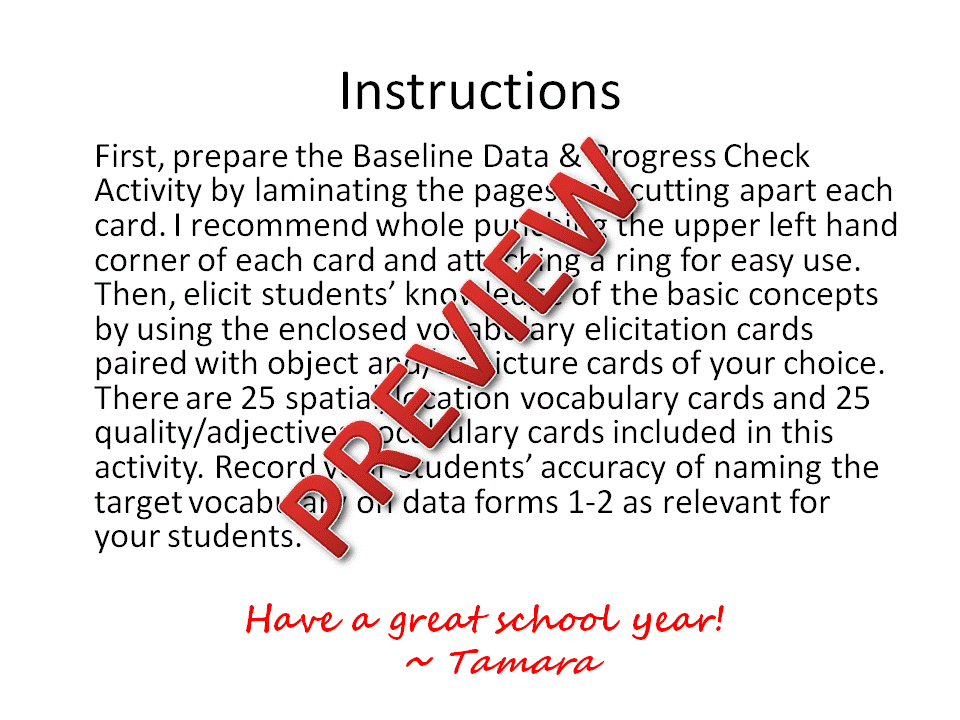
Basic Concepts Baseline Data & Progress Check Activity

Hey there everyone. Several of my students need direct vocabulary instruction and practice to master basic language concepts. This speech-language objective extends beyond the toddler and preschool age as many of my elementary school students with language disorders struggle with concepts. Their classroom teachers report that they are unable to follow basic directions in the classroom. This is often due to the fact that they do not comprehend the vocabulary in the verbal directions. 

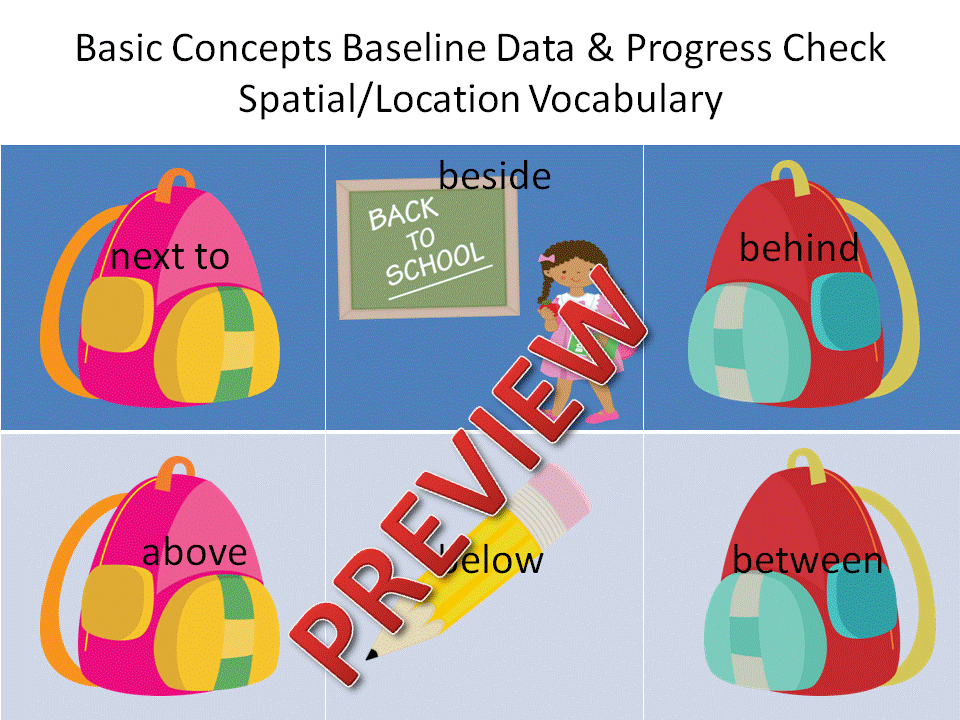
This product may be used as an assessment or progress monitoring tool. It has 25 spatial/location vocabulary cards and 25 quality/adjectives vocabulary cards that may be used to elicit their comprehension of these specific concepts.  I have also included 2 forms to record your students' understanding of the terms with ample space for additional progress monitoring administrations and recordings as well. 

Here is a preview:


This is available for purchase in my TPT store at: http://www.teacherspayteachers.com/Product/Basic-Concepts-Baseline-Data-Progress-Check-Activity-843349


I have 2 additional forms available to assess students' knowledge of quantity, sequential, temporal, and social-emotional/feelings language concepts as well. Check back for product availability for that time saving resource for student baseline data check and progress monitoring. 

****Product Update October 2015. I've added 3 additional levels of vocabulary elicitation cards. The spatial and qualitative concepts now include pictures that illustrate the concepts. When giving this informal assessment, you should give the student 1 step verbal direction paired with objects or pictures. These are the 4 levels of elicitation cards: 

1) receptive ID- school themed illustrations with text
    *pair with classroom object prompts

2) direct instruction- concept picture prompts with text

3) receptive ID- concept picture prompts only

4) expressive naming- concept picture prompts with cloze sentences


Thanks for visiting my blog today! Have a great day!


Tamara Anderson, M.S., CCC-SLP


Monday, August 12, 2013

Common Core Standards Vocabulary Giveaway!!!

I am having a back to school giveaway over the next 7 days of my 4th grade English/Language Arts Common Core Standards Vocabulary Activity. This packet has 60 multiple choice questions that assess several English/Language Arts standards that are relevant to what speech-language pathologists instruct during language therapy. 

It is important that language therapists integrate these national standards in our weekly therapy sessions with our students. The students' IEP goals and objectives should of course relate to their needs, but they should also relate to curriculum standards. 


These questions have been used in my language therapy sessions with my students last school year. I paired it with my basketball challenge game (http://www.teacherspayteachers.com/Product/Basketball-Challenge-Speech-Language-and-Academic-Skills-717131to maintain my students' engagement. However, it may be paired with your students favorite turn taking game during therapy or used as a stand alone activity in a literacy center in a regular or special education classroom.

This school year, I plan to give my 2nd, 3rd, 4th, and 5th grade English/Language Arts Common Core Standards Vocabulary packet questions to my students in order to collect baseline data at the beginning of the year. I will note my students' areas of mastery and needs so that I may effectively plan and implement future speech-language therapy lessons. These learning packets/task cards may also be used to review skills throughout the year and then as a reassessment prior to end of year state testing. 

In order to enter the contest for a chance to win, you are required to "like" my facebook page, follow my blog on Blog Lovin, or follow my Teachers Pay Teachers (TPT) page. Best of luck to you!!

So, head on over to my Facebook Page and sign up if you are not currently following BSL Speech Language there. Once there, click on the blue giveaway box for further details on entering the contest. 

Best of luck to you!!

https://www.facebook.com/BSLSpeechLanguage


Thanks for stopping by! 

Tamara Anderson, M.S., CCC-SLP

Sunday, July 28, 2013

Back to School Word Associations Freebie!!!

Hey everyone! This past week I returned from an awesome vacation in Cancun, Mexico. Here's a picture of Chichen Itza, one of the seven wonders of the world!!

Here's a picture of me in front of one of the Mayan ruins, Tulum. 


Upon checking my mail when I got home, I noticed the usual "back to school" greeting letter from the principal at the elementary school where I work. You know the letter, the one saying how much we are missed at school and how the administrative staff are anxiously awaiting our return because they are eager to start the school year or perhaps it is just too quiet during the summer. Well, that's when it hit me that my summer vacation is pretty much over. 

In my school district, I return to work this Wednesday, July 31st and have 5 preplanning days. Students return to school on Wednesday, August 7th. As my summer vacation is still a very present and pleasant memory, I allowed this information to abruptly sink in. In anticipation of this, I created a Back to School Word Association Freebie prior to leaving for my trip to gently ease myself into the reality of returning to work. Don't get me wrong, I love love love my job as a SLP!!  However, the summer always goes by way too fast. Anyhow, I often enjoy teaching my students about word associations because it is a great way to address vocabulary, memory, and overall receptive/expressive language skills at the same time. 

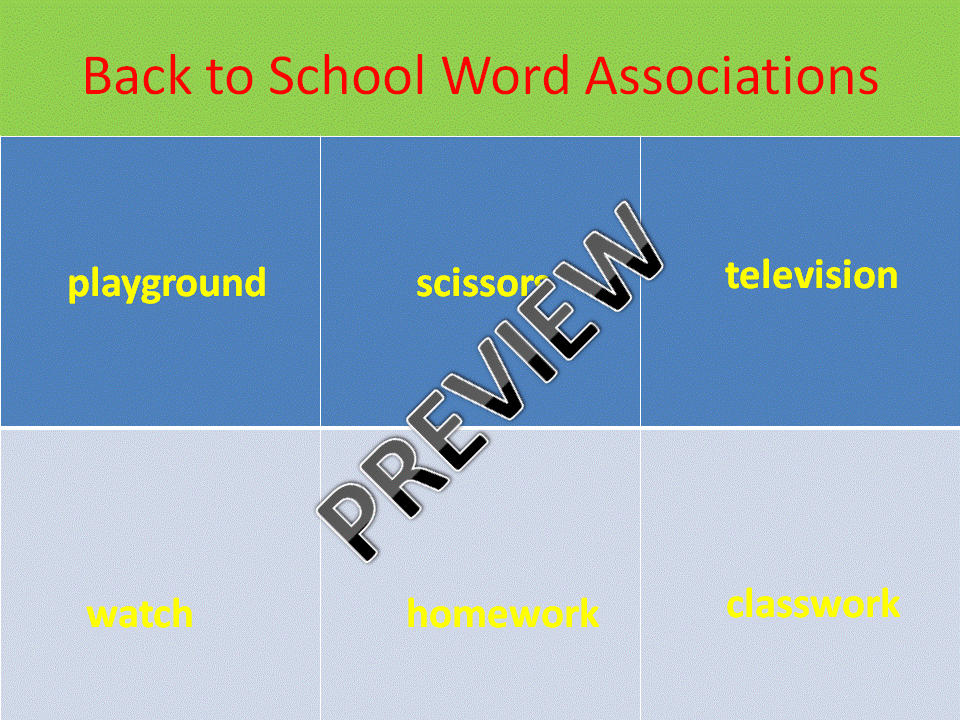
The Back to School Word Associations learning packet is ideal for students in kindergarten-third grade and targets 20 school related vocabulary words. I suggest doing a brief mini-lesson to introduce the concept of word associations before using the activity materials. Explain to your students that word associations are words that go together or are related by category, function, part/whole, synonyms, antonyms, etc and that today they will practice words that are related because they are in the same category of  "Back to School." The purpose of the activity is to allow each student in a speech-language group or language arts/literacy center to name 2-3 word associations for each target word. Here's a preview of this packet. 


You can get this freebie in my Teachers Pay Teachers (TPT) online store by clicking the link here: http://www.teacherspayteachers.com/Product/Back-to-School-Word-Associations-775946

If you want more information about the importance of teaching word associations click the link here to read one of my previous blog entries: http://www.bslspeechlanguage.blogspot.com/2013/03/why-teach-word-associations.html   

As always, thanks for visiting my page today. Check back soon for some language therapy giveaways!! 


Tamara Anderson, M.S., CCC-SLP   

SLP Back to Work This Week! 


Sunday, February 10, 2013

Baseball Themed Baseline & Progress Check Data Forms

I am excited to share that I have completed receptive and expressive language packets that include baseball themed data collection forms to address synonyms & antonyms, associations, multiple meanings, and irregular plural nouns/irregular past tense verbs. I decided to create these materials because I have several activities to use when providing speech-language services for my students.  Although my students love when I use different games and activities to target their vocabulary and grammar activities, the words elicited are not always the same each session and I needed a way to effectively measure their language progress over time. 

My solution for this dilemma was to make a quick way to keep track of my students' knowledge and use of specific vocabulary and grammar targets versus solely using data from a variety of question probes each session.   I love my new data tracking forms and have already starting using them to record my students' accuracy with each skill (baseline data) and will recheck their percentage of accuracy after additional language therapy sessions.

In my school district, we use an online documentation system to create Individualized Education Plans (IEPs). SLPs and other special education teachers are required to enter a percentage for baseline data at each annual review and then update progress online each 9 weeks for each goal/objective using a percentage of accuracy.

These forms will be great to record data for my elementary school aged children and I am sure other SLPs can utilize them as well!! You can administer the probes across 4 data collection days with this informal assessment tool. This will make your data collection much easier and reliable.


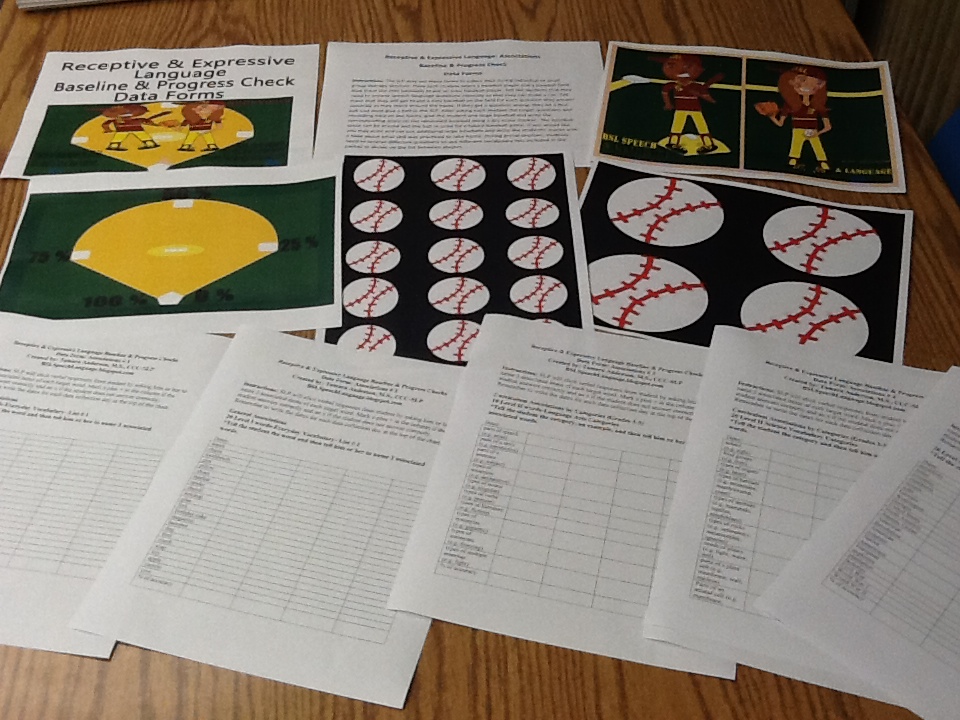
Here is a picture of the materials that I used with my students recently: 


I first used the synonyms data tracking form during a "baseball game" with one of my students who has mild autism and receptive/expressive language disorder. He was eager to play the game by naming synonyms as we have been practicing this skill for a while in therapy. He liked getting to put the mini baseballs on the field when he answered questions and made his way around the bases. After the student finished answering his questions, I wrote his score on a large baseball with a note about what language skill he practiced during therapy. He thought it was awesome that he got to take home a baseball ! You would have thought  that it was a real baseball and NOT just a paper version. He left my speech room with a big smile!! Small joys! :) 

These resources are available at my Teachers Pay Teachers Store at:http://www.teacherspayteachers.com/Product/Synonyms-Antonyms-Baseline-Data-Progress-Check-Forms
Here is what you will receive in the Synonyms & Antonyms Packet:

1) Cover page
2) Instructions page
3) Boy and girl baseball players; custom made illlustrations for BSL Speech Language
4) Baseball field custom made graphics for BSL Speech Language
5) 2 pages of different size custom made baseball graphics for BSL Speech Language
6) 2 Synonyms lists
7) 2 Antonyms lists  

Kindly leave your feedback in my TPT Store.

Thanks for reading the blog today, 

Tamara Anderson