Showing posts with label Documentation. Show all posts

Thursday, March 31, 2016

Balancing SLP Life as a School Based SLP {10 Success Tips}


The job of a speech-language pathologist truly varies based on her work setting and it is essential to know how to skillfully balance and complete tasks. For SLPs in the school setting, I have learned ways that make it easier to get the job done with excellence. After all, you need to have the energy, materials, and enthusiasm to provide your students with engaging speech language therapy sessions.  


If school based SLPs only had to complete evaluations and instruct students during therapy sessions, SLP life would be MUCH easier. However, you may start to feel like a professional juggler once you throw in attending special education eligibility meetings,  IEP meetings, re-evaluation meetings, data collection, writing reports, medicaid billing, team meetings, etc.  I have discovered 10 helpful tips that will ensure that you are effectively balancing your SLP life as a school based SLP. No, I don't have a magic wand to make your paperwork or computer work disappear. Sorry...so sorry. The good news is that I have 10 success tips that will help you manage the therapy, paperwork, and meeting aspects of your job. 

THERAPY TIPS:
1) Gather seasonal/holiday themed materials on Thursdays and Fridays before the season changes or upcoming holiday. Keep them in an accessible place that is near your therapy table. 

*Fiction/non-fiction books (with companions/related activities)
*Speech-language activities from Teachers Pay Teachers (TPT)
*Token boards (fall, winter, spring, summer, holidays)
*Game boards
*Sports games (football, basketball, soccer, baseball)
*Seasonal worksheets for mixed articulation/language goals
*iPad activities 

2) Vary activities in monthly sessions to maintain engagement. 

Students can sense when you are not interested or excited about   an activity. It's okay to switch activities from one that you initially   planned on using that day. Remember to try your best to make sessions meaningful, educationally relevant, yet fun! 

PAPERWORK TIPS:
3) Use progress monitoring forms for articulation, speech fluency, and language objectives.  
* Store master copies in a binder near therapy table. 
* Put forms in students' group therapy folder so that you can easily 
   use them on data collection days (e.g. I organize attendance 
   sheets, data sheets, therapy printables in folders per group). 
* Remember that you do NOT have to take therapy data in every 
   session!

4) Schedule time to write IEPs and evaluation reports. 

It will hold you accountable with getting paperwork done with less stress. If you didn't get to complete what you planned, just scratch it out in your planner and re-assign it to another day's task list.

5) Arrive to work early or stay late to complete documentation. 

I think it's important to set boundaries between SLP work life and personal life. I recommend that you avoid bringing home student files, IEP work, evaluation reports, or medicaid billing. 

If you have children, you may try arranging for extended childcare 
hours 2 days a week so that you can arrive early or stay late at work to complete documentation. You may be surprised how a slight adjustment will improve your efficiency.  

EVALUATION & MEETING TIPS:
6) Schedule daily tasks in your planner. 

Write down meeting dates and times. Note changes to usual schedule such as testing student vs. typical therapy session. 

7) Schedule time for lunch (social meeting).

I think that it is important to give yourself at least 30 minutes that does not involve you eating at your desk while checking emails or doing other paperwork. 

8) Schedule time to test students for upcoming speech/language screenings, comprehensive evaluations, and re-evaluations.

Contact SLP testers in your district if they are available to help lighten your testing load. 

9) Learn to politely say no. 
I know that you may want to help serve as a team member on special school projects, committees, and clubs. However, you most likely don't have time to attend these extra meetings.  It's perfectly ok to say no without feeling guilty. 

Instead, you can attend after school events (e.g. concerts, literacy night) to support your students and build rapport with families when you can. 

10) Request to be excused from some meetings.
With parental permission, you can be excused from IEP meetings. Since SLPs typically have high caseloads and often must cancel therapy sessions to attend meetings, it is appropriate to be excused from attending an IEP meeting. However, you should always use your professional judgement when asking to be excused. This will need to be documented in the IEP online documentation or meeting minutes. It is best to send home speech therapy updates and proposed goals & objectives in advance when possible. 

Check out my TPT store for time-saving theme based activities and progress monitoring tools. These resources are engaging therapy materials and will simplify the data collection process with your students! 

Thanks for reading the blog. These tips help me tremendously during the school year. I'm now in the final stretch of the school year, but first it's time for SPRING BREAK! 

Tamara Anderson

Sunday, February 28, 2016

Why Do You Teach Categorization in Speech-Language Therapy ?

Many children with language disorders struggle with understanding the skill of categorization. Pediatric speech-language pathologists frequently write objectives for children to improve their ability to name items in categories, name categories when given items in the group, and identify what items do not belong in a category. SLPs select these objectives in therapy often because a child did not demonstrate mastery of this skill on an assessment. 

Do you really think about why this is such an important language concept for your client with communication disorder to master? As speech-language pathologists, we need to be able to readily explain to parents, special education teachers, and administrators, the reason we are targeting categorization in speech-language therapy as well as the skilled therapy techniques we use to improve this area.  

Children need to learn categorization because it is a critical language processing skill. Semantic or vocabulary processing is a large part of how children understand language and effectively retrieve words. After young children learn to label basic nouns and express their functions (e.g. verbs) during their daily routines, they naturally progress to learn word associations. Categorization is typically the next skill in this developmental hierarchy. 

Children need to learn categorization because when they do, it helps them effectively store new words and information in their brain. In doing so, they connect a new vocabulary word or concept to their schema or pattern of knowledge that they already know. For example, when a child learns the subcategory of desserts his or her brain makes an association because he or she already knows that is a type of food. When an older child learns about the water cycle, he or she can make meaning based on previous knowledge about weather, types of precipitation (rain, sleet, snow, etc.), and/or sequence of events. 

Preschool children and children in grades K-2 with language disorders need to learn various categorization tasks with Tier I vocabulary words. They need to practice divergent naming task or expressing items in categories such as food, clothes, transportation, and shapes. They need to practice convergent naming tasks that require them to say the category name when told examples of items in that category. Similarly, they need to be able to distinguish what item does not match the group during an elicited task. 

Children in grades 3-5 can further their development of categorization by practicing divergent and convergent naming tasks with Tier III academic vocabulary. Since many speech-language pathologists support teaching the language underpinnings of the common core state standards, they can teach their students how to categorize English/Language Arts vocabulary. For example, students can sort parts of speech vocabulary, types of nouns, types of literature terms, or figurative language vocabulary into groups. They can name Tier III words when given a category and state the category when given examples in this group. 

So, what materials do you use to take data, instruct children, and provide language practice opportunities for categorization objectives? I have several items in my TPT store to work on these goals. Some of these include:

1) Categories Data Check- 8 forms to quickly assess Tier I vocab
       * If you own my Vocabulary Progress Monitoring Tool, it will be updated with this  
          expanded category data check. Email me if you have questions at tamaraanderson.bsl@gmail.com
2) My Speech Language Category Book- sorting Tier III E/LA 
    vocab
3) E/LA Comprehensive Categorization Bundle- Tier I & III vocab
4) E/LA Vocabulary Memory Concentration Activity

So the next time someone asks you why you teach categorization in speech therapy? You can remind them that you also provide language therapy and then effectively explain your rationale. 

Thanks for reading my blog today! 

Until next time,

Tamara Anderson


Tuesday, January 19, 2016

January 2016 Sale-bration! 1/20th-1/21st


I have some great news to share! My Teachers Pay Teachers (TPT) curriculum store will be on sale this Wednesday and Thursday! I am joining in on the fun for the Start Your Year Inspired TPT sale! You can save 28 % when you enter the sale code, START16, when you checkout. This is a great way to gain immediate access to some great speech-language therapy and English/Language Arts products. Don't miss out on purchasing my specially created resources if you haven't already!! Make sure that you follow my blog this week because it is also my 3 year Blogiversary and there will be other EXCITING announcements!!!!


It's always great to have new activities to use in speech-language therapy and time-saving progress monitoring tools too! As busy SLPs or educators, it's helpful when we have a variety of effective materials to improve the communication, language, and literacy skills of children! Thanks for reading my blog today. Until next time...
Visit my curriculum store here!

Tamara Anderson


Sunday, November 1, 2015

Product Feature: Wh Questions Progress Monitoring Tool

In May of this year, I realized that I needed to create a WH Questions Progress Monitoring Tool because so many children on my caseload were working on improving their language processing skills in this area. I provide therapy services for many children who have receptive/expressive language disorder with co-occurring autism, specific learning disability, and/or intellectual disability and struggle immensely with this skill. 

This tool has really enabled me to improve my ability to take data prior to beginning intervention with kids and after several speech-language therapy sessions.  

Last month, I expanded this tool from 6 progress monitoring forms with 75 question probes to 12 progress monitoring forms with 165 question probes to evaluate children's ability to answer who, what, where, when, and why questions about everyday events. This informal assessment is ideal for use in therapy sessions with kids identified with a communication disorder and for children in the Response to Intervention (RTI) process. 


This WH Questions Progress Monitoring Tool includes:

1) 25 Who Questions- 10 questions for baseline data elicitation and post intervention progress check; 5 questions for 2 week interval checks (3 of these) *same for what, where, when, and why Q's
2) 25 What Questions 
3) 25 Where Questions
4) 25 When Questions
5) 25 Why Questions
6) 40 Mixed Wh Questions- 25 questions for baseline data elicitation and post intervention progress check; 5 questions for 2    
week interval checks (3 of these)

It is recommended that this tool is used prior to beginning language therapy or RTI instruction with a child on a targeted comprehension skill. Then, the SLP or teacher should give the included 5 question data check every 2 weeks to monitor progress. Next, the SLP or teacher should repeat the longer wh questions data check after 8 weeks or more to assess a child's comprehension and oral expression skills in the targeted areas. Last, I have included a data summary form to record all data for easy review. 

This essential informal assessment product is available in my TPT store.  Here is what some buyers had to say about it:

"Great product! I am an SLP at an elementary school and we do a lot of "Wh" questions. This is going to be a great way to progress monitor!"

Incredibly helpful assessment tool! :)

Great resource to use in the RTI process!

Thanks for reading the blog today. Make sure you purchase this essential tool to enhance your ability to take data. Click here to access a complimentary digital download of my one page WH questions freebie.

Tamara Anderson


Sunday, August 23, 2015

Back to School Baseline Data


Hey everyone. I know that many school based speech-language pathologists have already returned to work and many will start back soon. Tomorrow will be the beginning of my 4th week back at work and 3rd week for students. After the initial excitement and sleepiness of going back to school and work has worn of, speech-language pathologists need to make sure that they take baseline data on their students' IEP objectives. For many kids there will be some variability in their scores from the end of the school year to their beginning of the school year data. However, with a quick re-teaching of the skill they are back to where they were previously. 

Some of you may be thinking, so what really is baseline data? This is the data, percentages, or measurable information that you collect to informally assess specific skills outlined in a child's IEP objectives. ASHA's Evidence Based Practice Glossary states that baseline is "a benchmark, measurement, or calculation used as a basis for comparison." 

Many SLPs consider the first data point gathered on a skill an accurate measure for baseline while I have heard others say that they consider 3 data points as baseline data. I have created several quick informal assessment and/or progress monitoring tools that will make it easy for you to gather this data. Just click here to access these digital downloads to help simplify your SLP life.  

I have assessment tools for oral story retell, basic concepts, vocabulary (Tier I semantic processing- object function, similarities, differences, etc), associations, wh questions, irregular plurals, irregular past tense verbs, speech fluency, speech intelligibility, synonyms, antonyms, multiple meaning words, and English/Language Arts Tier III curriculum vocabulary.  I have personally used these tools frequently in my speech language sessions with students on my caseload. 

I suggest making several copies of the forms that you need to record baseline data and keep them in a binder. I typically select the forms that I need for each student and place them in my daily student therapy files. Using informal assessments/progress monitoring forms have truly improved my ability to quantify the skills of my speech-language students. This also helps as I record progress check data throughout the school year.  

I hope you have a great school year! Make sure you subscribe to 
my blog: Building Successful Lives by entering your email in the right hand column above. This way you will get my blog articles sent directly to your inbox. I look forward to you reading what I have to share :)

Tamara Anderson


Sunday, August 2, 2015

Speech-Language Curriculum Assessments


I am absolutely thrilled about my newest product, Speech-Language Curriculum Assessments that is available in my TPT store!!! It is designed for use by speech-language pathologists who support teaching the language underpinnings of the 3rd grade English/Language Arts Common Core State Standards. Other grade levels will be available in the future. 


I provide educationally relevant speech-language therapy frequently and this product is a great way to assess students knowledge of the language underpinnings of the Common Core Standards related to skills that SLPs instruct. This is a must have if you work as a school based SLP. SLPs have the clinical skills needed to provide direct vocabulary instruction that will improve students' ability to learn the standards. Here are some examples of terms assessed in red below.


/


This product contains 13 curriculum assessments that are informal standards based evaluation tools in a cloze sentence format with a word bank.  They can be used to collect baseline or pre-assessment data and for post-assessments after the vocabulary words are taught in speech-language therapy sessions. 

The assessments provided will evaluate students' understanding of the vocabulary skills that are needed to master 3rd grade standards. As a bonus, I have also included English/Language Arts vocabulary assessments according to categories such as types of nouns, types of sentences, parts of speech, story vocabulary, types of literature, types of writing, figurative language, and prefixes.

I hope that this product will assist you in providing educationally relevant speech-language therapy services!  

This product pairs well with my language interventions Guess What? Curriculum Bundle and English/Language Arts Common Core Vocabulary Bundle. 

Thanks for reading my Building Successful Lives blog today. Make sure that you subscribe by entering your email in the box in the right hand column of this page. Stay connected and remember that SLPs are building speech, language, academic, and social skills of kids everyday! Keep up the great work! :) I'm back to work full-time tomorrow. Summer break is officially over. 

Tamara Anderson

Wednesday, November 12, 2014

Speech Progress Monitoring {Product Launch & Giveaway}

Over the years, I have provided speech therapy for several preschool to middle school age children who stutter.  I know how valuable it is to have a way to quickly take data on the frequency of a child's dysfluent episodes, types of stuttering, stuttering severity, and secondary behaviors during therapy sessions. That's why I am thrilled to share with you what has helped make my fluency intervention sessions a breeze!!


My latest product, Speech Progress Monitoring, was released last week in my TPT online store. It includes my speech fluency data collection tool that is perfect for progress monitoring in the speech room, general education classroom, or home environment. On the form, the SLP should record the setting the speech sample is taken, type of sample (e.g. picture description, story retell, conversation) and write tally marks to indicate each spoken syllable. Under each tally mark for a dysfluent episode, use the provided acronyms to record the types of stuttering. The formula to calculate the percentage of stuttering or severity is included. As a bonus, the SLP can circle if any secondary behaviors were observed during the speech sample. Using this form, will improve your ability to write fluency objectives such as the child naming the types of stuttering and reducing the percentage of stuttering in different speaking situations using fluency strategies. 

In speech therapy, there is a definite need to also have a speech intelligibility data collection tool. The progress monitoring form that I created provides a quick and easy way to calculate the percentage of speech intelligibility for children. I currently use this tool for children on my caseload with moderate intellectual disabilities. Many of these children struggle with speech articulation at the word, sentence, and conversational levels as well as with their communication partners understanding their speech. With direct intervention, the SLP can facilitate improving the speech intelligibility or the level that their speech is understood by familiar and unfamiliar speakers. This tool is essential for all speech language pathologists addressing increasing speech intelligibility with kids on their caseload. 

So head over to my TPT store to purchase this awesome resource at an incredible price! 

http://www.teacherspayteachers.com/Product/Speech-Progress-Monitoring-Fluency-Intelligibility-1537215

Enter here for a chance to win 2 of my latest progress monitoring tools in honor of ASHA in Florida! The winners will be notified next Thursday! :a Rafflecopter giveaway  


Tamara Anderson
BSL Speech & Language


Tuesday, November 11, 2014

Vocabulary Progress Monitoring {Product Launch & Giveaway}

I am excited that my latest product, Vocabulary Progress Monitoring, is available for use by speech-language pathologists and can be purchased in my TPT store. This essential and effective informal assessment tool assesses 300 vocabulary words. 

                                              
http://www.teacherspayteachers.com/Product/Vocabulary-Progress-Monitoring-1520541

I have personally used these quick evaluation tools with children who have speech-language disorders to measure their semantic processing skills. Several SLPs purchased this product last week during my November 7th Must Have sale so I know this is a necessary product to have handy in your speech-language therapy room.

The resource is organized by vocabulary skills that require increasing receptive and expressive language abilities. In this extensive resource, you will receive vocabulary progress monitoring documentation forms to evaluate these specific semantic skills:

1) Object functions- 20 words (school & home items)
2) Word associations- 40 words
3) Categories- 10 groups
4) Similarities/Differences- 10 words
5) Synonyms/Antonyms- 40 synonyms, 40 antonyms
6) Multiple meaning words- 90 words
7) Oral definitions with Tier I words- 10 words
8) Oral definitions with Tier III (academic) words- 20
9) Figurative language- 20 words

I recommend making an assessment binder with several copies of each form and keeping them in sheet protectors. This way you can easily access them when you need to complete an informal vocabulary assessment for a student. 

This must have progress monitoring tool is on sale now in my TPT store for one week only because I know how much you need this product! As a special gift to my blog readers,  enter now for a chance to win my 2 latest progress monitoring tools! The winners will be notified next Thursday in honor of ASHA in Florida! a Rafflecopter giveaway  


Thanks for visiting the blog today. 

Tamara Anderson
BSL Speech & Language


Sunday, August 25, 2013

Basic Concepts Baseline Data & Progress Check Activity

Hey there everyone. Several of my students need direct vocabulary instruction and practice to master basic language concepts. This speech-language objective extends beyond the toddler and preschool age as many of my elementary school students with language disorders struggle with concepts. Their classroom teachers report that they are unable to follow basic directions in the classroom. This is often due to the fact that they do not comprehend the vocabulary in the verbal directions. 

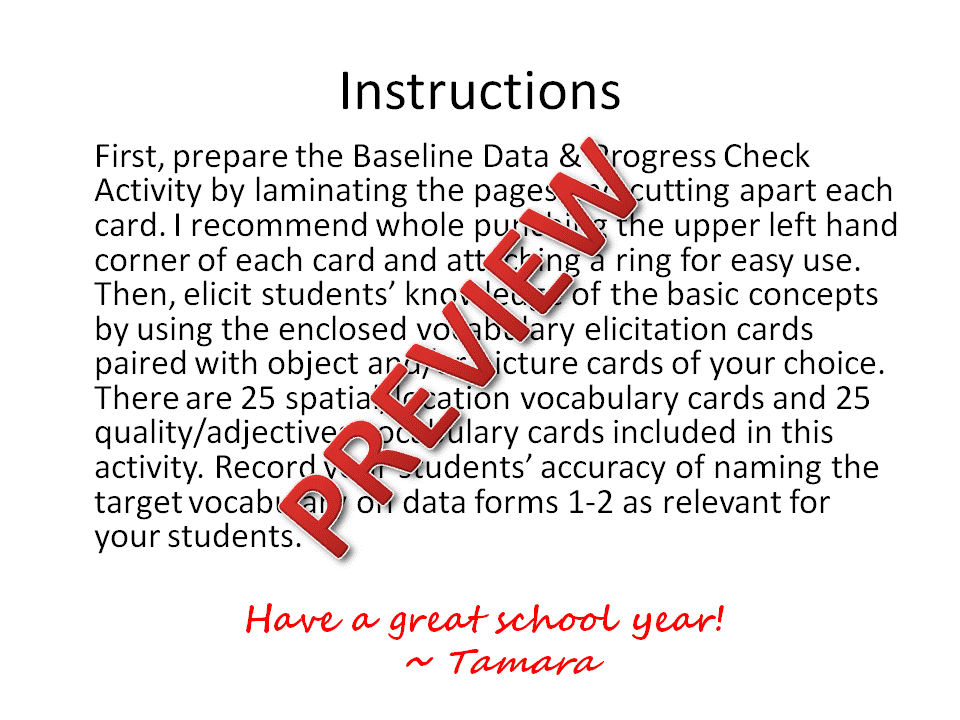
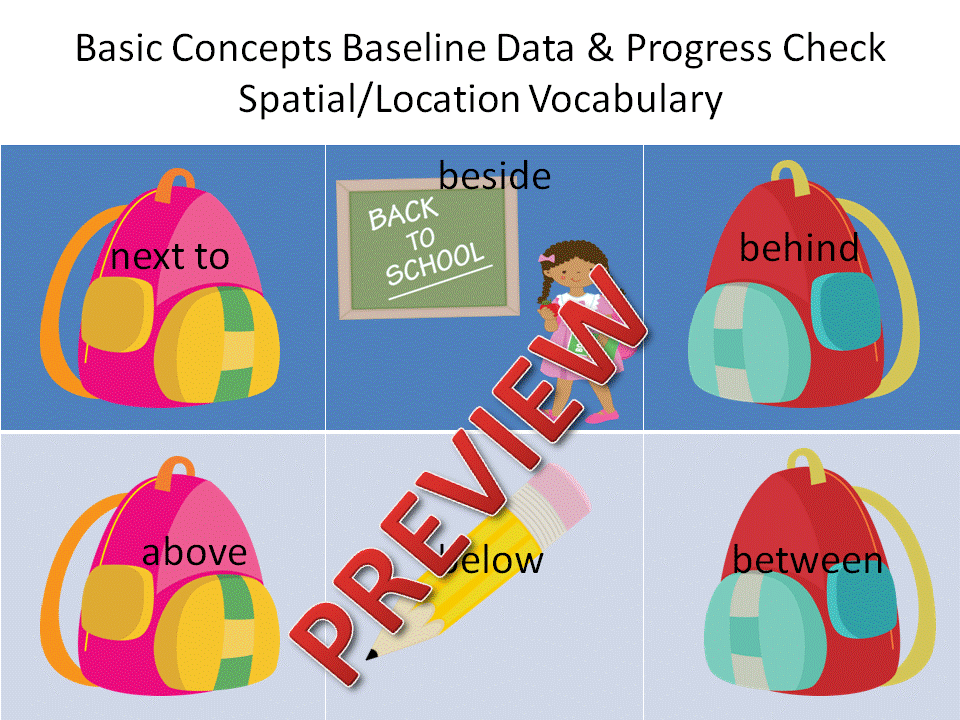
This product may be used as an assessment or progress monitoring tool. It has 25 spatial/location vocabulary cards and 25 quality/adjectives vocabulary cards that may be used to elicit their comprehension of these specific concepts.  I have also included 2 forms to record your students' understanding of the terms with ample space for additional progress monitoring administrations and recordings as well. 

Here is a preview:


This is available for purchase in my TPT store at: http://www.teacherspayteachers.com/Product/Basic-Concepts-Baseline-Data-Progress-Check-Activity-843349


I have 2 additional forms available to assess students' knowledge of quantity, sequential, temporal, and social-emotional/feelings language concepts as well. Check back for product availability for that time saving resource for student baseline data check and progress monitoring. 

****Product Update October 2015. I've added 3 additional levels of vocabulary elicitation cards. The spatial and qualitative concepts now include pictures that illustrate the concepts. When giving this informal assessment, you should give the student 1 step verbal direction paired with objects or pictures. These are the 4 levels of elicitation cards: 

1) receptive ID- school themed illustrations with text
    *pair with classroom object prompts

2) direct instruction- concept picture prompts with text

3) receptive ID- concept picture prompts only

4) expressive naming- concept picture prompts with cloze sentences


Thanks for visiting my blog today! Have a great day!


Tamara Anderson, M.S., CCC-SLP


Sunday, March 3, 2013

Why Teach Word Associations?

As speech-language pathologists, we recognize the significance of  providing direct vocabulary instruction for students who have language impairments on a weekly basis. Students need to improve their receptive and expressive vocabulary skills so that they can improve their functional communication, listening comprehension, reading comprehension, and overall understanding of their grade level curriculum.
Teaching word associations is essential to students' vocabulary acquisition and understanding of word relationships.

What are the advantages of teaching word associations?

1) increases receptive and expressive vocabulary skills
2) increases students' abilities to understand and explain similarities/differences
3) prerequisite skill for students to understand grade level/curriculum level compare and contrast activities
4) prerequisite skill for students to understand word relationships in analogies that requires students to use basic level deductive reasoning skills
5) supports common core English/Language Arts standards
6) reinforces skill of categorization that requires students to sort items into groups, name items according to group, identify/name items that don't belong in a group
7) increases understanding of age level, grade level, and curriculum vocabulary
8) research supports direct instruction of word associations

Evidence based practice

Research supports the need for direct vocabulary instruction. Marzano (2004) agrees that there is a strong case for the importance and usefulness of direct vocabulary instruction. He states “the research indicates that wide reading probably is not sufficient in itself to ensure that students will develop the necessary vocabulary and consequently the necessary academic background knowledge to do well in school. In contrast, direct vocabulary instruction has an impressive track record of improving students’ background knowledge and the comprehension of academic content.”  


What resources can SLPs and teachers use to address these skills?

Word Associations Baseline and Progress Check Data Forms: Grades 1- 5
Available in my TPT store: http://www.teacherspayteachers.com/Product/Associations-Baseline-Progress-Check-Data-Forms

This packet includes baseball themed data collection forms for SLPs or teachers to record students' accuracy of naming word associations. Students play a baseball game by choosing a player and take turns hitting the baseballs by naming 2 associated words for each target word. If they get a question right, they get a mini baseball to put on their baseball field. If they miss the question, they "hit" a foul ball and the SLP gets the ball. If they answer approximately 15-20 questions correctly, they safely make a "run" by making it to home base and collect enough baseballs to fill up the path.

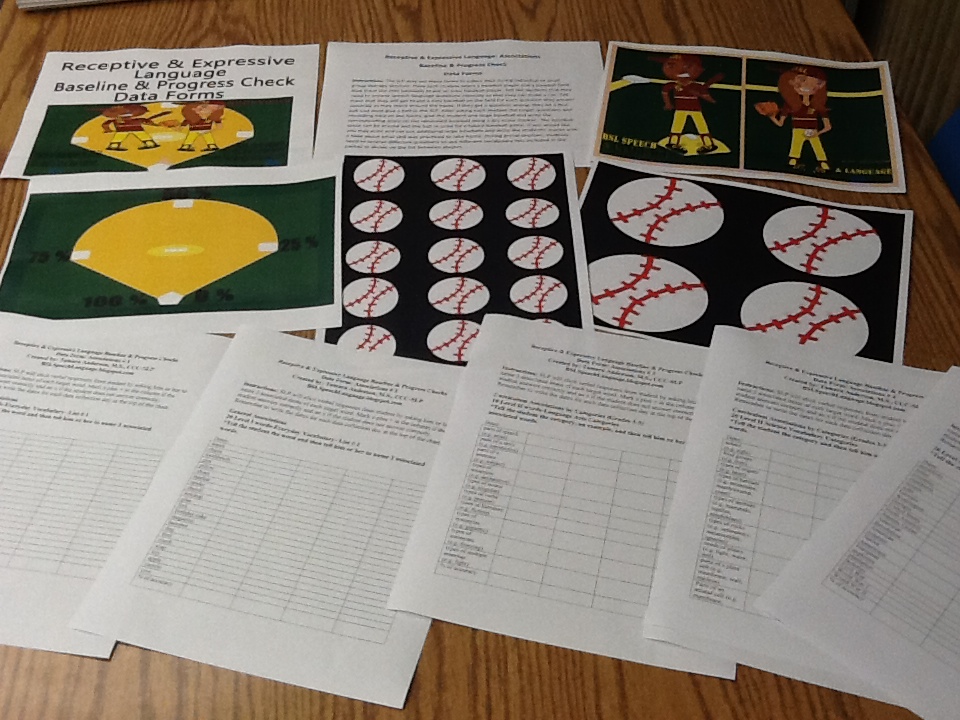
The Packet includes the following pages:
1) Cover page
2) Instructions page
3) Boy and girl baseball players; custom made illustrations for BSL Speech Language
4) Baseball field custom made graphics for BSL Speech Language
5) 2 pages of different size custom made baseball graphics for BSL Speech Language
6) 2 General Associations lists (Grades 1-3)
7) 1 Language Arts Associations List (Grades 3-5)
8) 1 Science Associations List (Grades 3-5)
9) 1 Social Studies Associations List (Grades 3-5)

No Glamour Vocabulary book by Linguisystems, Inc.

Monday Update: 3/4/13
Today in language therapy, I reviewed word associations with 2 of my 3rd grade groups. First, I reviewed the meanings of word associations. Then, I did a mini lesson and guided practice activity. I listed basic words such as dog, apple, and bookbag and had them name associated words as I wrote them on a mini dry erase board. Then, I had them look at our "word wall" of language arts words that had story vocabulary listed (e.g. character, character traits, author, illustrator, narrator, etc.). I asked them: What is the category or topic of  these vocabulary words? My students required prompting to answer, so I asked them exclusionary questions: Are these math vocabulary? Are these science vocabulary? Are these social studies vocabulary? Are these language arts vocabulary? After that, I modeled making a graphic organizer to review the lesson and we used markers to make the vocabulary more visually appealing (plus using markers are more fun!!). Here is the one I created:

Additional Resources to teach word associations:

Help for Word Finding book by Linguisystems, Inc.


Pair Ups Association Cards by Linguisystems, Inc.


I PAD app Word to Word by MochiBits: best used with 4th, 5th, and middle school students


Numerous TPT resources created by SLPs


* For those that love using technology, I suggest saving a selection of frequently used TPT activities in iBooks on your IPAD for easy access in speech-language therapy sessions. I recently started doing this and it is a great addition and time saver!! 


*I suggest purchasing/adding Pocket Game Super Pack by Danielle Reed in iBook. The activity has activities to address word associations via analogies that target action/object, characteristics, location, and part/whole analogies


* I suggest purchasing/adding Rachel Lynette's tasks cards for analogies in iBook and printing/laminating to create a file folder activity


What educational resources do you use to teach word associations?

Kindly share your comments!! Thanks for visiting the blog today. 

Reference

Marzano, R. (2004). Building background knowledge for academic achievement: research on   
          what works in the schools. Alexandria, VA: Association for Supervision and Curriculum    
          Development.


Sunday, February 10, 2013

Baseball Themed Baseline & Progress Check Data Forms

I am excited to share that I have completed receptive and expressive language packets that include baseball themed data collection forms to address synonyms & antonyms, associations, multiple meanings, and irregular plural nouns/irregular past tense verbs. I decided to create these materials because I have several activities to use when providing speech-language services for my students.  Although my students love when I use different games and activities to target their vocabulary and grammar activities, the words elicited are not always the same each session and I needed a way to effectively measure their language progress over time. 

My solution for this dilemma was to make a quick way to keep track of my students' knowledge and use of specific vocabulary and grammar targets versus solely using data from a variety of question probes each session.   I love my new data tracking forms and have already starting using them to record my students' accuracy with each skill (baseline data) and will recheck their percentage of accuracy after additional language therapy sessions.

In my school district, we use an online documentation system to create Individualized Education Plans (IEPs). SLPs and other special education teachers are required to enter a percentage for baseline data at each annual review and then update progress online each 9 weeks for each goal/objective using a percentage of accuracy.

These forms will be great to record data for my elementary school aged children and I am sure other SLPs can utilize them as well!! You can administer the probes across 4 data collection days with this informal assessment tool. This will make your data collection much easier and reliable.


Here is a picture of the materials that I used with my students recently: 


I first used the synonyms data tracking form during a "baseball game" with one of my students who has mild autism and receptive/expressive language disorder. He was eager to play the game by naming synonyms as we have been practicing this skill for a while in therapy. He liked getting to put the mini baseballs on the field when he answered questions and made his way around the bases. After the student finished answering his questions, I wrote his score on a large baseball with a note about what language skill he practiced during therapy. He thought it was awesome that he got to take home a baseball ! You would have thought  that it was a real baseball and NOT just a paper version. He left my speech room with a big smile!! Small joys! :) 

These resources are available at my Teachers Pay Teachers Store at:http://www.teacherspayteachers.com/Product/Synonyms-Antonyms-Baseline-Data-Progress-Check-Forms
Here is what you will receive in the Synonyms & Antonyms Packet:

1) Cover page
2) Instructions page
3) Boy and girl baseball players; custom made illlustrations for BSL Speech Language
4) Baseball field custom made graphics for BSL Speech Language
5) 2 pages of different size custom made baseball graphics for BSL Speech Language
6) 2 Synonyms lists
7) 2 Antonyms lists  

Kindly leave your feedback in my TPT Store.

Thanks for reading the blog today, 

Tamara Anderson