I'm now in my 2nd week of summer break from work as a school based speech-language pathologist in the metro Atlanta area. It was a great and busy school year!
I am enjoying my time in Florida since the memorial day weekend. It is always so refreshing to spend time in my beautiful sunshine and home state of Florida. Here's a picture of me at a new spot my family and I discovered named Ponce Inlet that is located a little south of Ormond Beach.
As I reflect on the past school year, I am so grateful that I got to contribute to building successful lives™ in my students every day. It truly is rewarding to see their growth that is evident when I observe their communication skills and review my DATA! I think I am certainly the queen of progress monitoring as I have a form for just about everything I need! You can check some of those out here.
Each year, I look forward to attending 5th grade graduation for my students and this year was no different. I wrote personalized letters for each child that recognized the gains they made in speech-language therapy and encouraged them to continue to succeed in MIDDLE school. I loved handing them out after the ceremony and snapping photos. I felt like such a proud MAMA not just their SLP! Ha! I still can't believe some of my kiddos are moving on from elementary. I have worked with some of them for the past four years.
When I chatted with parents, they shared their appreciation for me working with their child over the years. I know that I made a difference in enriching their child's life from the conversations we had and their desire to snap keepsake photos! It makes me smile just thinking about it. :)
This year, I not only provided direct speech-language therapy for children with communication disorders, learning disabilities, Autism, intellectual disabilities, and behavioral challenges but also provided consultative/direct services to children in the Response to Intervention process.
I enjoyed seeing the progress students made receiving listening comprehension and oral language interventions. I also liked collecting background information like a sleuth to determine whether kids needed a referral for special education evaluation, then assessing them and analyzing evaluation results to determine whether they would qualify for a speech-language impairment eligibility and subsequent therapy services. I had several tricky cases this year including determining whether there was a language difference due to English Language Learner needs or a true language disorder.
I also served on the SLP leadership team for my district, facilitated local team meetings, and supervised 2 new hires for their Georgia state license. It was a great opportunity to contribute to the professional growth of these young women.
When it was all said and done, it was a rewarding school year. The smiles of my students, the hugs, and the multiple "I'll miss you this summer" confirm that I was certainly building successful lives one day at a time this school year.
I am glad for the summer break from my school SLP role, yet I am excited for all that is in store for Building Successful Lives™ Speech & Language Services. Stay connected by subscribing to the blog by email so that you receive blog articles directly into your email account. Have a great rest of the school year for those still at work this month. Keep up the great work for those working in pediatric private practice or early intervention as well! You can do it! :)
Tamara Anderson
Wednesday, June 3, 2015
Monday, May 4, 2015
Technology and Response to Intervention {RTI Blog Hop}
I am excited to be a part of this School Based Innovation and RTI Blog Hop hosted by Jennifer Preschern at Speech, Language, and Literacy Lab, LLC! Thanks for the opportunity to share my ideas about RTI during ASHA's Better Hearing and Speech Month!
Speech-language pathologists definitely play a role in Response to Intervention or RTI as early identification of children at risk for speech-language challenges is essential to our scope of practice. RTI is a tiered system that requires quality evidence based instruction, universal screening, and progress monitoring of specific learning targets. In my school district, I have observed that many teachers have a good understanding of implementing research based instruction for students according to the curriculum. However, they need assistance with providing different strategies and educational opportunities for students that are not learning as expected. They often need assistance with progress monitoring identified weak speech, language, and academic skills.
This is where the use of technology can help provide research based intervention while also recording the accuracy of students' performance. There has been an increase in the use of technology in speech-language therapy, education, and in homes throughout the world. Many kids are very knowledgeable about using computers and iPads. Although technology should never replace social interactions and oral communication, it can be a valuable tool. When implemented correctly, technology can support direct instruction and provided practice for kids working on different speech-language therapy and academic skills.
I recommend HearBuilder Educational Software Program by Super Duper Publications because it provides interventions to address phonological/phonemic awareness skills, auditory memory, following directions, and listening comprehension (sequencing). The program is research based and provides mini instructional lessons as well as independent practice opportunities to address previously identified areas of need. This year, my speech language pathology department purchased the internet subscription for SLPs to use in the ENTIRE district! How awesome is that! I have seen success using the program for students receiving RTI as well as those receiving speech-language therapy.
For example, many kindergarten and 1st grade teachers have reported that their students have difficulty learning early reading skills such as rhyming, blending sounds to make words, segmenting words into sounds, etc. This program has a specific module to address these phonemic awareness skills that a speech-language pathologist can assign as a Tier 2 or Tier 3 intervention. The SLP can select from the following specific early reading skills for each student to practice and the program will track the percentage of accuracy as well:
Phoneme Addition, Phoneme Blending, Phoneme Deletion, Phoneme Manipulation, Phoneme Segmentation & Identification, Rhyming, Sentence Segmentation, Syllable Blending, Syllable Segmentation
I recommend periodically watching students as they complete learning tasks, reviewing and printing data. Doing so, will enable the SLP to best make adjustments as needed to settings of the selected computer based intervention based on students' performance.
I have also observed that many children at risk for language disorders and learning disabilities struggle with auditory memory. The HearBuilder program has an excellent component that addresses memory for numbers, words, WH questions, details, and auditory closure. I suggest selecting 1 or 2 sections of the auditory memory program to provide intensive intervention in the students' weak areas. As they progress through the different levels within each section, you can give them access to complete another memory module (e.g. memory for WH questions).
Similarly, the following directions intervention section of this program has a systematic hierarchy that builds from: basic concepts (qualitative, spatial), quantitative, sequential, temporal, conditional. I recommend that the SLP change the settings of the program so each student only has access to practice 1 or 2 sections. Many regular education teachers often report that students do not following directions in the classroom. It may be because they do not understand basic vocabulary concepts that are addressed in the HearBuilder program.
The sequencing intervention provides practice with listening to information to put instructions and stories in order. Sequencing is a critical skill that is essential for successful verbal and written narrative development. Many kids at risk for a speech-language disorder or learning disability struggle in this area.
In addition to using the data tracking in HearBuilder, you may also use other informal assessment tools to monitor students progress in RTI. For example, I have a FREEBIE for you that can be used to record baseline and progress check data for "Wh" questions in my TPT store here.
I have other progress monitoring tools in my TPT store for basic concepts (qualitative, spatial) and vocabulary (hierarchy of semantic processing). Just click on the progress monitoring custom category to review the resources available for speech-language pathologists, educators, or RTI specialists to use.
Thanks for reading the blog today. Make sure you read Starfish Therapies' RTI blog article tomorrow and other posts the rest of the month. You can learn more about Starfish Therapies here if you need direct speech-language, physical, or occupational therapy services and you live in San Francisco, California. Thanks for joining the celebration today for Better Hearing and Speech Month!
Tamara Anderson, M.S., Ed.S., CCC-SLP
Speech-Language Pathologist
Education Specialist
Speech-language pathologists definitely play a role in Response to Intervention or RTI as early identification of children at risk for speech-language challenges is essential to our scope of practice. RTI is a tiered system that requires quality evidence based instruction, universal screening, and progress monitoring of specific learning targets. In my school district, I have observed that many teachers have a good understanding of implementing research based instruction for students according to the curriculum. However, they need assistance with providing different strategies and educational opportunities for students that are not learning as expected. They often need assistance with progress monitoring identified weak speech, language, and academic skills.
This is where the use of technology can help provide research based intervention while also recording the accuracy of students' performance. There has been an increase in the use of technology in speech-language therapy, education, and in homes throughout the world. Many kids are very knowledgeable about using computers and iPads. Although technology should never replace social interactions and oral communication, it can be a valuable tool. When implemented correctly, technology can support direct instruction and provided practice for kids working on different speech-language therapy and academic skills.
I recommend HearBuilder Educational Software Program by Super Duper Publications because it provides interventions to address phonological/phonemic awareness skills, auditory memory, following directions, and listening comprehension (sequencing). The program is research based and provides mini instructional lessons as well as independent practice opportunities to address previously identified areas of need. This year, my speech language pathology department purchased the internet subscription for SLPs to use in the ENTIRE district! How awesome is that! I have seen success using the program for students receiving RTI as well as those receiving speech-language therapy.
For example, many kindergarten and 1st grade teachers have reported that their students have difficulty learning early reading skills such as rhyming, blending sounds to make words, segmenting words into sounds, etc. This program has a specific module to address these phonemic awareness skills that a speech-language pathologist can assign as a Tier 2 or Tier 3 intervention. The SLP can select from the following specific early reading skills for each student to practice and the program will track the percentage of accuracy as well:
Phoneme Addition, Phoneme Blending, Phoneme Deletion, Phoneme Manipulation, Phoneme Segmentation & Identification, Rhyming, Sentence Segmentation, Syllable Blending, Syllable Segmentation
I recommend periodically watching students as they complete learning tasks, reviewing and printing data. Doing so, will enable the SLP to best make adjustments as needed to settings of the selected computer based intervention based on students' performance.
I have also observed that many children at risk for language disorders and learning disabilities struggle with auditory memory. The HearBuilder program has an excellent component that addresses memory for numbers, words, WH questions, details, and auditory closure. I suggest selecting 1 or 2 sections of the auditory memory program to provide intensive intervention in the students' weak areas. As they progress through the different levels within each section, you can give them access to complete another memory module (e.g. memory for WH questions).
Similarly, the following directions intervention section of this program has a systematic hierarchy that builds from: basic concepts (qualitative, spatial), quantitative, sequential, temporal, conditional. I recommend that the SLP change the settings of the program so each student only has access to practice 1 or 2 sections. Many regular education teachers often report that students do not following directions in the classroom. It may be because they do not understand basic vocabulary concepts that are addressed in the HearBuilder program.
The sequencing intervention provides practice with listening to information to put instructions and stories in order. Sequencing is a critical skill that is essential for successful verbal and written narrative development. Many kids at risk for a speech-language disorder or learning disability struggle in this area.
In addition to using the data tracking in HearBuilder, you may also use other informal assessment tools to monitor students progress in RTI. For example, I have a FREEBIE for you that can be used to record baseline and progress check data for "Wh" questions in my TPT store here.
I have other progress monitoring tools in my TPT store for basic concepts (qualitative, spatial) and vocabulary (hierarchy of semantic processing). Just click on the progress monitoring custom category to review the resources available for speech-language pathologists, educators, or RTI specialists to use.
Thanks for reading the blog today. Make sure you read Starfish Therapies' RTI blog article tomorrow and other posts the rest of the month. You can learn more about Starfish Therapies here if you need direct speech-language, physical, or occupational therapy services and you live in San Francisco, California. Thanks for joining the celebration today for Better Hearing and Speech Month!
Tamara Anderson, M.S., Ed.S., CCC-SLP
Speech-Language Pathologist
Education Specialist
Wednesday, April 29, 2015
Spring into Literacy: Teaching Phonological Awareness
Recently I have been working on phonological awareness skills with a 1st grade speech fluency student who also has difficulty with reading decoding and reading fluency. I provide services for an older elementary school student as well with language impairment that struggles immensely with basic literacy skills. From my observation, this is not an area that all speech-language therapists address. However, literacy is a part of our scope of practice according to ASHA.
These literacy areas are considered appropriate roles and responsibilities for SLPs: 1) preventing written language problems by fostering language acquisition and emergent literacy 2) identifying children at risk for reading and writing problems 3) assessing reading and writing 4) providing intervention and documenting outcomes for reading and writing 5) providing consultation to teachers, parents, students about effective literacy practices
Woah! Did you realize how in depth our responsibilities can extend in the area of literacy? SLPs can assist with reading & written expression. Say what? I know we have a lot on our plates working with the listening and speaking components of literacy so to think about helping with reading and written expression may be a bit daunting. After all, the resource special education teachers directly teach that for our IEP kiddos.
Nevertheless, a few years ago, I decided to get additionally training in the area of reading. I quickly observed that many of my students with speech-language impairment had a language based learning disability in the areas of reading and writing. Therefore, I completed a Georgia State University reading endorsement certification program. I learned valuable reading assessment and instruction best practices in this program that I can use when I provide consultation for students in the RTI process. It also helps me know what to do as I directly address phonological awareness with students from time to time.
So, what is phonological awareness? This is the term used to describe essential literacy skills that require a child to manipulate syllables, words, and sounds. These are auditory skills that generally begin at age three and are typically mastered by ages 6-7 if a child does not have a reading disability.
Here is what an SLP can do to teach this skill:
1) create word lists of rhyming and non-rhyming words
*Tell the child 2-3 words. Then ask, "do these words rhyme?"
*Give a child a target word and ask "What rhymes with ____?"
2) create word lists for syllable counting (segmentation) activities
*Tell and show a child a word and ask "How many syllables are in these words?"
3) create word lists with compound words and other multi-syllabic words * Have kids combine syllables to express words. For example, say "What word do you hear when I say hot...dog?
What is phonemic awareness? This is a component of phonological awareness and involves skills such as phoneme blending, phoneme segmenting, phoneme deletion, phoneme substitution.
Here are tips on how to work on these 4 skills:
*Use letters that you can manipulate such as these foam letters from Dollar Tree.

1) blend or combine sounds to say words
c-a-r, w-a-t-ch, b-o-o-k, p-e-n-c-i-l, p-l-a-y
2) verbally segment or separate sounds when given words
mom, dad, crayon, water, bear
3) verbally delete or omit a sound from a word to say a new word
say plate without /p/, say mat without the /m/
4) verbally change a sound to another sound
say /hat/, now take away /h/ and add /b/ or change /h/ to /b/
say /sun/, now take away /s/ and add /f/ or change /s/ to /f/
I highly recommend Hearbuilder Phonological Awareness program. It is available as an iPad or iPhone app or as paid subscription for use on the internet.
I hope you learned some new information or refreshed your memory about how to teach phonological awareness skills. These can be used in speech-language therapy sessions or shared while consulting with general education teachers as they deliver RTI interventions in the classroom.
Thanks for reading the blog today!
Tamara Anderson
*******
Reference: Lanza, Janet; Flahive, L. (2012) Guide to Communication Milestones. East Moline, IL: LinguiSystems, Inc.
These literacy areas are considered appropriate roles and responsibilities for SLPs: 1) preventing written language problems by fostering language acquisition and emergent literacy 2) identifying children at risk for reading and writing problems 3) assessing reading and writing 4) providing intervention and documenting outcomes for reading and writing 5) providing consultation to teachers, parents, students about effective literacy practices
Woah! Did you realize how in depth our responsibilities can extend in the area of literacy? SLPs can assist with reading & written expression. Say what? I know we have a lot on our plates working with the listening and speaking components of literacy so to think about helping with reading and written expression may be a bit daunting. After all, the resource special education teachers directly teach that for our IEP kiddos.
Nevertheless, a few years ago, I decided to get additionally training in the area of reading. I quickly observed that many of my students with speech-language impairment had a language based learning disability in the areas of reading and writing. Therefore, I completed a Georgia State University reading endorsement certification program. I learned valuable reading assessment and instruction best practices in this program that I can use when I provide consultation for students in the RTI process. It also helps me know what to do as I directly address phonological awareness with students from time to time.
So, what is phonological awareness? This is the term used to describe essential literacy skills that require a child to manipulate syllables, words, and sounds. These are auditory skills that generally begin at age three and are typically mastered by ages 6-7 if a child does not have a reading disability.
Here is what an SLP can do to teach this skill:
1) create word lists of rhyming and non-rhyming words
*Tell the child 2-3 words. Then ask, "do these words rhyme?"
*Give a child a target word and ask "What rhymes with ____?"
2) create word lists for syllable counting (segmentation) activities
*Tell and show a child a word and ask "How many syllables are in these words?"
3) create word lists with compound words and other multi-syllabic words * Have kids combine syllables to express words. For example, say "What word do you hear when I say hot...dog?
What is phonemic awareness? This is a component of phonological awareness and involves skills such as phoneme blending, phoneme segmenting, phoneme deletion, phoneme substitution.
Here are tips on how to work on these 4 skills:
*Use letters that you can manipulate such as these foam letters from Dollar Tree.
1) blend or combine sounds to say words
c-a-r, w-a-t-ch, b-o-o-k, p-e-n-c-i-l, p-l-a-y
2) verbally segment or separate sounds when given words
mom, dad, crayon, water, bear
3) verbally delete or omit a sound from a word to say a new word
say plate without /p/, say mat without the /m/
4) verbally change a sound to another sound
say /hat/, now take away /h/ and add /b/ or change /h/ to /b/
say /sun/, now take away /s/ and add /f/ or change /s/ to /f/
I highly recommend Hearbuilder Phonological Awareness program. It is available as an iPad or iPhone app or as paid subscription for use on the internet.
I hope you learned some new information or refreshed your memory about how to teach phonological awareness skills. These can be used in speech-language therapy sessions or shared while consulting with general education teachers as they deliver RTI interventions in the classroom.
Thanks for reading the blog today!
Tamara Anderson
*******
Reference: Lanza, Janet; Flahive, L. (2012) Guide to Communication Milestones. East Moline, IL: LinguiSystems, Inc.
Tuesday, April 28, 2015
Educationally Relevant Speech-Language Therapy- Supporting the Common Core Standards
The job of a speech-language pathologist varies tremendously based on the setting and the population that she or he serves. However, in the school setting it has become increasingly important that the SLP provide speech-language therapy that is educationally relevant. So, what exactly does that mean?
With the integration of the Common Core State Standards in most school districts, SLPs need to align informal assessments and therapy activities with these standards as much as possible. At the same time, they need to always consider what is developmentally appropriate for a child. In my district in metro Atlanta, the grade level curriculum changed in August 2013 when it became a requirement for educators to instruct students according to the Common Core State Standards. Other states were already implementing new curriculum based on these standards while other districts decided not to adopt them. Many of the English/Language Arts Common Core State Standards directly relate to skills that SLPs are accustomed to instructing kids about in therapy.
My current caseload includes students with speech-language impairment and co-occurring specific learning disability, autism, intellectual disabilities, and/or other health impairment (e.g. ADHD). I have a few students who have a speech-language impairment only eligibility that I provide therapy to improve their articulation or speech fluency skills.
From my experience, I have found it easiest to integrate educationally relevant therapy to students in grades 3-5 with language disorders and co-occurring learning disability. There are many standards that relate to having students identify the multiple meanings of words, use context clues to identify the meanings of unknown words, identify word relationships, name synonyms, name antonyms, identify Greek & Latin prefixes/suffixes, explain figurative language expressions, and answer comprehension questions from non-fiction text.
In addition, the language standards require that students demonstrate an understanding of the parts of speech. In doing so, they need to be able to speak and write using pronouns, nouns, verbs, adjectives, conjunctions, prepositions, adverbs, and interjections. Using correct subject/verb agreement is another important element of mastering the language standards.
Now that you have examples of skills to address. Where do you start? I recommend using formal and informal assessments to determine starting points in therapy. SLPs can analyze results from tests such as the OWLS II, CELF 5, CASL or LPT 3 and note weak areas that relate to grade level Common Core State Standards.
There are also informal curriculum based language measures that you can use to evaluate students' strengths and weaknesses such as Nicole Allison's Curriculum-Based Language Assessments.
I created an English/Language Arts Vocabulary Progress Monitoring tool to informally evaluate expressive curriculum vocabulary skills of children. Often times, kids learn to comprehend definitions and identify terms when given choices, but they still struggle orally explaining the meanings. This tool assesses 105 words that are a language foundation for many of the E/LA Common Core State Standards.
For students who are working on receptive vocabulary skills, I created Speech-Language Therapy Curriculum Assessments aligned with the English/Language Arts Common Core State Standards to evaluate these skills. This informal tool will be available in my TPT store in the future. I have used these assessment probes frequently in my language therapy room and seen progress with my students. Working on vocabulary in language therapy is essential for students' comprehension of skills and mastery of the curriculum.
After gathering baseline data from an informal speech-language assessment, the SLP can target objectives related to students' areas of need AND that also relate to curriculum Common Core State Standards.
For example, for students that need direct SLP intervention with multiple meaning words you may use:
For students that need direct SLP intervention with context clues you may use:
For students that need direct SLP intervention with synonyms & antonyms you may use:
Many students with language disorders also need intervention with oral language in the area of morphology and syntax. You can use my freebie Parts of Speech Graphic Organizer or Back to School Irregular Plural Nouns & Past Tense Verbs.
Two of my favorite bundles to use to address the E/LA Common Core Standards are :

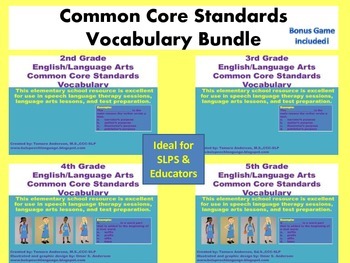
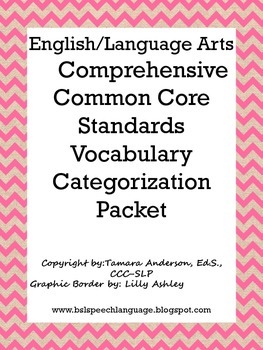
The first bundle provides a great mixed review of a variety of E/LA standards while the second bundle provides great intervention in the area of categorization and word relationships.
Make sure you subscribe to my blog to read additional articles related to educationally relevant speech-language therapy and Common Core State Standards aligned resources. Stay tuned for a Speech-Language Therapy Common Core Standards Guide where you can get more detailed informational about specific relevant standards for SLPS, informal assessments and products to use in therapy that will help you provide curriculum relevant intervention.
Thanks for reading the blog today!
Tamara Anderson
My current caseload includes students with speech-language impairment and co-occurring specific learning disability, autism, intellectual disabilities, and/or other health impairment (e.g. ADHD). I have a few students who have a speech-language impairment only eligibility that I provide therapy to improve their articulation or speech fluency skills.
From my experience, I have found it easiest to integrate educationally relevant therapy to students in grades 3-5 with language disorders and co-occurring learning disability. There are many standards that relate to having students identify the multiple meanings of words, use context clues to identify the meanings of unknown words, identify word relationships, name synonyms, name antonyms, identify Greek & Latin prefixes/suffixes, explain figurative language expressions, and answer comprehension questions from non-fiction text.
In addition, the language standards require that students demonstrate an understanding of the parts of speech. In doing so, they need to be able to speak and write using pronouns, nouns, verbs, adjectives, conjunctions, prepositions, adverbs, and interjections. Using correct subject/verb agreement is another important element of mastering the language standards.
Now that you have examples of skills to address. Where do you start? I recommend using formal and informal assessments to determine starting points in therapy. SLPs can analyze results from tests such as the OWLS II, CELF 5, CASL or LPT 3 and note weak areas that relate to grade level Common Core State Standards.
There are also informal curriculum based language measures that you can use to evaluate students' strengths and weaknesses such as Nicole Allison's Curriculum-Based Language Assessments.
I created an English/Language Arts Vocabulary Progress Monitoring tool to informally evaluate expressive curriculum vocabulary skills of children. Often times, kids learn to comprehend definitions and identify terms when given choices, but they still struggle orally explaining the meanings. This tool assesses 105 words that are a language foundation for many of the E/LA Common Core State Standards.
For students who are working on receptive vocabulary skills, I created Speech-Language Therapy Curriculum Assessments aligned with the English/Language Arts Common Core State Standards to evaluate these skills. This informal tool will be available in my TPT store in the future. I have used these assessment probes frequently in my language therapy room and seen progress with my students. Working on vocabulary in language therapy is essential for students' comprehension of skills and mastery of the curriculum.
My Vocabulary Progress Monitoring Tool also provides great informal data about various semantic processing skills in a systematic hierarchy.
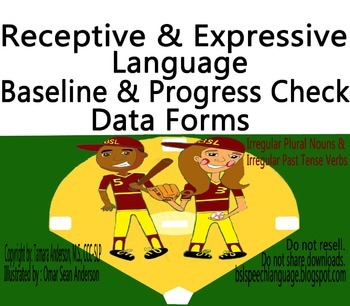
My Irregular Plural Nouns & Irregular Past Tense Verbs Baseline & Progress Check Data Forms may be used to determine students' expressive knowledge of these grammar targets.
For example, for students that need direct SLP intervention with multiple meaning words you may use:
For students that need direct SLP intervention with context clues you may use:
Many students with language disorders also need intervention with oral language in the area of morphology and syntax. You can use my freebie Parts of Speech Graphic Organizer or Back to School Irregular Plural Nouns & Past Tense Verbs.
Two of my favorite bundles to use to address the E/LA Common Core Standards are :
The first bundle provides a great mixed review of a variety of E/LA standards while the second bundle provides great intervention in the area of categorization and word relationships.
Make sure you subscribe to my blog to read additional articles related to educationally relevant speech-language therapy and Common Core State Standards aligned resources. Stay tuned for a Speech-Language Therapy Common Core Standards Guide where you can get more detailed informational about specific relevant standards for SLPS, informal assessments and products to use in therapy that will help you provide curriculum relevant intervention.
Thanks for reading the blog today!
Tamara Anderson
Sunday, April 26, 2015
Speech-Language Therapy Technology Resource Guide
I am excited that my complimentary Speech-Language Therapy Resource Guide is now available in my TPT store!! I have wanted to put this together for a while now and I am glad that it is done! I am sure that I will add resources to this guide from time to time. When you follow my TPT store and subscribe to my blog, you will receive direct notifications of product updates.
I have many students who are working on answering wh questions and I often have them practice using Webber Interactive "WH" Questions CD by Super Duper Publications. I love this CD because it provides a brief lesson for each type of question and then the child can practice answering the specific question set that he or she needs to work on. You can select an option to provide the child with a field of 2-4 choices and I usually select a field of 4 choices. Another awesome part is the CD tracks the child's accuracy. At the end of the session, I just print the data and put it in the child's file. I also frequently have students who are practicing listening comprehension at the story level use Auditory Memory for Quick Stories (Fiction)CD or Auditory Memory High-Interest Quick Stories (Non-Fiction) CD that also tracks students' data.
Another way to integrate technology into speech-language therapy sessions is to lead a whole group or individual session using a resource that directly addresses a specific learning target for your student or client. In the guide, you will find a list of interactive websites, iPad Apps, video clips, SMART Board lessons, and iBook lessons. You will also find a list of resources according to speech-language therapy work areas of need such as speech articulation, speech fluency, language, vocabulary, grammar, listening comprehension, auditory memory, pragmatic language, and phonological awareness. I have also included a list of helpful websites that have great printables and general information beneficial for SLPs.
For example, I frequently use the website jacobslessons.com with my K-2 students who need practice with prepositions and pronouns. I use do2learn.com with students who need to work on categorization (what doesn't belong) or synonyms and antonyms. My 3rd-5th grade students are pros at using henryanker.com to practice synonyms and antonyms. Although this website states that it has tests by grade level, I use them as therapy instructional activities.
As you know, there are tons of iPad Apps. It is important that the SLP carefully selects apps that will directly address the needs of each speech language student or client. You want them to have fun interacting with technology, but it needs to be meaningful and therapeutic as well. Therefore, the SLP will need to introduce the app as she would a usual speech language activity and then guide them through or modify the app as needed to work towards mastery of the skill being taught.
Many SLPs use iPads in therapy and it can also be a great tool to download and organize TPT digital speech-language activities into iBooks. This way you can have easy access to a library of fantastic therapy lessons. I recommend using my 2nd-5th Grade Common Core Standards Vocabulary task cards in iBooks to provide educationally relevant therapy.
For those that provide direct therapy in a general education or special education classroom, you may use several lessons included in this guide on a SMART Board.
I hope that you take time to explore this guide as you plan to integrate new technology resources into your speech-language therapy sessions with your students or clients. Keep in mind that technology should never replace skilled direct therapy instruction by a licensed SLP. Kids still need personal interactions to learn and practice communication and language skills. However, technology can be used to supplement more traditional therapy lessons.
Remember the overall goal of speech-language therapy is for students or clients to make gains in their communication, language, and literacy skills. In doing so, they will make progress towards or master their IEP speech-language objectives or goals in private practice therapy.
Thanks for reading the blog today!
Tamara Anderson
So, you may be wondering, "why would a speech-language pathologist want to integrate technology in therapy sessions?" There are so many reasons. If you are a school based speech-language pathologist, this provides you a great way to differentiate instruction by what you are teaching (content), how (process), and product (end result). You can assign one or two students to work at a technology station with headphones while you interact directly with others.
I have many students who are working on answering wh questions and I often have them practice using Webber Interactive "WH" Questions CD by Super Duper Publications. I love this CD because it provides a brief lesson for each type of question and then the child can practice answering the specific question set that he or she needs to work on. You can select an option to provide the child with a field of 2-4 choices and I usually select a field of 4 choices. Another awesome part is the CD tracks the child's accuracy. At the end of the session, I just print the data and put it in the child's file. I also frequently have students who are practicing listening comprehension at the story level use Auditory Memory for Quick Stories (Fiction)CD or Auditory Memory High-Interest Quick Stories (Non-Fiction) CD that also tracks students' data.
Another way to integrate technology into speech-language therapy sessions is to lead a whole group or individual session using a resource that directly addresses a specific learning target for your student or client. In the guide, you will find a list of interactive websites, iPad Apps, video clips, SMART Board lessons, and iBook lessons. You will also find a list of resources according to speech-language therapy work areas of need such as speech articulation, speech fluency, language, vocabulary, grammar, listening comprehension, auditory memory, pragmatic language, and phonological awareness. I have also included a list of helpful websites that have great printables and general information beneficial for SLPs.
For example, I frequently use the website jacobslessons.com with my K-2 students who need practice with prepositions and pronouns. I use do2learn.com with students who need to work on categorization (what doesn't belong) or synonyms and antonyms. My 3rd-5th grade students are pros at using henryanker.com to practice synonyms and antonyms. Although this website states that it has tests by grade level, I use them as therapy instructional activities.
As you know, there are tons of iPad Apps. It is important that the SLP carefully selects apps that will directly address the needs of each speech language student or client. You want them to have fun interacting with technology, but it needs to be meaningful and therapeutic as well. Therefore, the SLP will need to introduce the app as she would a usual speech language activity and then guide them through or modify the app as needed to work towards mastery of the skill being taught.
Many SLPs use iPads in therapy and it can also be a great tool to download and organize TPT digital speech-language activities into iBooks. This way you can have easy access to a library of fantastic therapy lessons. I recommend using my 2nd-5th Grade Common Core Standards Vocabulary task cards in iBooks to provide educationally relevant therapy.
For those that provide direct therapy in a general education or special education classroom, you may use several lessons included in this guide on a SMART Board.
I hope that you take time to explore this guide as you plan to integrate new technology resources into your speech-language therapy sessions with your students or clients. Keep in mind that technology should never replace skilled direct therapy instruction by a licensed SLP. Kids still need personal interactions to learn and practice communication and language skills. However, technology can be used to supplement more traditional therapy lessons.
Remember the overall goal of speech-language therapy is for students or clients to make gains in their communication, language, and literacy skills. In doing so, they will make progress towards or master their IEP speech-language objectives or goals in private practice therapy.
Thanks for reading the blog today!
Tamara Anderson
Tuesday, March 31, 2015
Speech-Language Success Stories # 6
I am currently in the last 9 weeks of the school year in my district and spring break is 3 days away!! Speech-language therapy progress notes and report cards went home with kids last Friday. Naturally, SLPs review our students' data and document speech-language objectives that they have mastered, made progress, and areas that they may be struggling with learning a skill.
My success story today is about having students celebrate their victories in the speech language therapy room. I have a poster that says "Super Speech Students- We Are Meeting Goals!!!" Students put a star sticker on the chart for each objective that they meet based on their Individualized Education Plan (IEP) mastery criteria. They really seem to enjoy looking at the incentive poster and counting their stars.
I also have many of them graph their progress and take home their graph when they meet a goal! I can not count the times that I hear "What's my score?" or "Did I do good today?" They know that I take data regularly and that I desire for them to LEARN and improve their scores or percentages of accuracy. Many of them can't wait to get their hands on my handy Super Duper clipboard that has a calculator at the top. Occasionally, I let a few of them enter the fraction to figure out their percentage of accuracy. I teach them how to convert the decimal to a percentage too! Math in the speech-language room! Say What?!
At the end of the 9 weeks, which usually coincides with a holiday too, I bring edible treats to reward their hard work towards meeting goals. Here are some goodies that I handed out today.
I also gave out new stickers! Remember to celebrate students' successes in your speech-language therapy sessions or classroom too!
Tamara Anderson
SLP on Spring Break Soon
Guess What? SLP Lingo & Test Prep Vocabulary
My speech-language therapy students are quite accustomed to me pulling out all sorts of vocabulary activities during their weekly sessions. I wanted a new way to help them practice saying the meanings of their key speech-language therapy and English/Language Arts words. So many of my students with language based learning disabilities struggle with verbally defining their curriculum vocabulary and many of them have memory deficits as well. After all, true mastery of a concept is when they can understand and explain the concept.
This was my motivation behind creating my Guess What? Frequently Used SLP Lingo & Test Prep Vocabulary Game. This is the 4th in this series. I wanted a fun way for my speech language kiddos to practice their curriculum vocabulary skills. This was an instant hit in my sessions!!!
To play this curriculum game, I select one semantic map from the set to focus on during a 30 minute session.
Research shows that the use of semantic or vocabulary maps is an excellent memory and learning strategy because it helps children successfully organize and retrieve information from their brains. Score! You can read more about that here as I did research on that as well when I completed my Education Specialist (Ed.S.) degree. http://bslspeechlanguage.blogspot.com/search/label/Brain%20Based%20Learning
Then I have each student in a group choose a mystery word and tell them to make sure they don't let the others see it!
Then I put the question prompts page on the table and a word bank.
I love the variety of visuals available in this game because it allows you to differentiate instruction without your kids even knowing it.
For example, some kids may just need the semantic map when it's their turn to ask a question while others will read directly from the question prompts page or another student will just need the word bank page to formulate his/her question.
Students will take turns asking their opponents a question to try to guess or figure out their mystery word. If someone guesses their word, they pick another word from the deck. The game continues until all the vocabulary from the selected semantic map are guessed.
My speech-language 4th and 5th graders absolutely LOVE this game and they get SUPER competitive too which I don't mind because they're practicing their learning objectives. This game will work well for middle school students too! There are 5 semantic maps with 40 Frequently Used SLP Lingo and 5 semantic maps with 40 Test Prep Vocabulary. Your students will have several weeks of language intervention to practice 80 words with this curriculum game!
You may purchase this product in my online TPT store here:
https://www.teacherspayteachers.com/Product/Guess-What-SLP-Lingo-Test-Prep-Vocabulary-1788007
I have three other Guess What? Curriculum Games in this series that are also favorites with my speech kiddos. They are available in my TPS store as well.
1) Guess What? Types of Literature, Story Elements, & Text Features
2) Guess What? Types of Sentences, Parts of Sentences, & Parts of
Speech
3) Guess What? Figurative Language, Prefixes, & Suffixes
https://www.teacherspayteachers.com/Product/Guess-What-Figurative-Language-Prefixes-Suffixes-1621952
Thanks for reading the blog today! :)
Tamara Anderson
This was my motivation behind creating my Guess What? Frequently Used SLP Lingo & Test Prep Vocabulary Game. This is the 4th in this series. I wanted a fun way for my speech language kiddos to practice their curriculum vocabulary skills. This was an instant hit in my sessions!!!
To play this curriculum game, I select one semantic map from the set to focus on during a 30 minute session.
Research shows that the use of semantic or vocabulary maps is an excellent memory and learning strategy because it helps children successfully organize and retrieve information from their brains. Score! You can read more about that here as I did research on that as well when I completed my Education Specialist (Ed.S.) degree. http://bslspeechlanguage.blogspot.com/search/label/Brain%20Based%20Learning
Then I have each student in a group choose a mystery word and tell them to make sure they don't let the others see it!
Then I put the question prompts page on the table and a word bank.
I love the variety of visuals available in this game because it allows you to differentiate instruction without your kids even knowing it.
For example, some kids may just need the semantic map when it's their turn to ask a question while others will read directly from the question prompts page or another student will just need the word bank page to formulate his/her question.
Students will take turns asking their opponents a question to try to guess or figure out their mystery word. If someone guesses their word, they pick another word from the deck. The game continues until all the vocabulary from the selected semantic map are guessed.
My speech-language 4th and 5th graders absolutely LOVE this game and they get SUPER competitive too which I don't mind because they're practicing their learning objectives. This game will work well for middle school students too! There are 5 semantic maps with 40 Frequently Used SLP Lingo and 5 semantic maps with 40 Test Prep Vocabulary. Your students will have several weeks of language intervention to practice 80 words with this curriculum game!
You may purchase this product in my online TPT store here:
https://www.teacherspayteachers.com/Product/Guess-What-SLP-Lingo-Test-Prep-Vocabulary-1788007
I have three other Guess What? Curriculum Games in this series that are also favorites with my speech kiddos. They are available in my TPS store as well.
1) Guess What? Types of Literature, Story Elements, & Text Features
2) Guess What? Types of Sentences, Parts of Sentences, & Parts of
Speech
3) Guess What? Figurative Language, Prefixes, & Suffixes
https://www.teacherspayteachers.com/Product/Guess-What-Figurative-Language-Prefixes-Suffixes-1621952
Tamara Anderson
Subscribe to:
Posts (Atom)